Citizenship Is No Longer Final: Turkey’s Mass Cancellations, Ireland’s New Revocation Powers, Jordan’s Price Hike & Vanuatu’s Andrew Tate Revocation
Citizenship approval is no longer necessarily the end of the story. From Turkey’s mass cancellations and Ireland’s proposed new revocation powers to Jordan’s higher investment threshold and Vanuatu’s latest citizenship revocation, governments are placing greater scrutiny on citizenship long after approval.
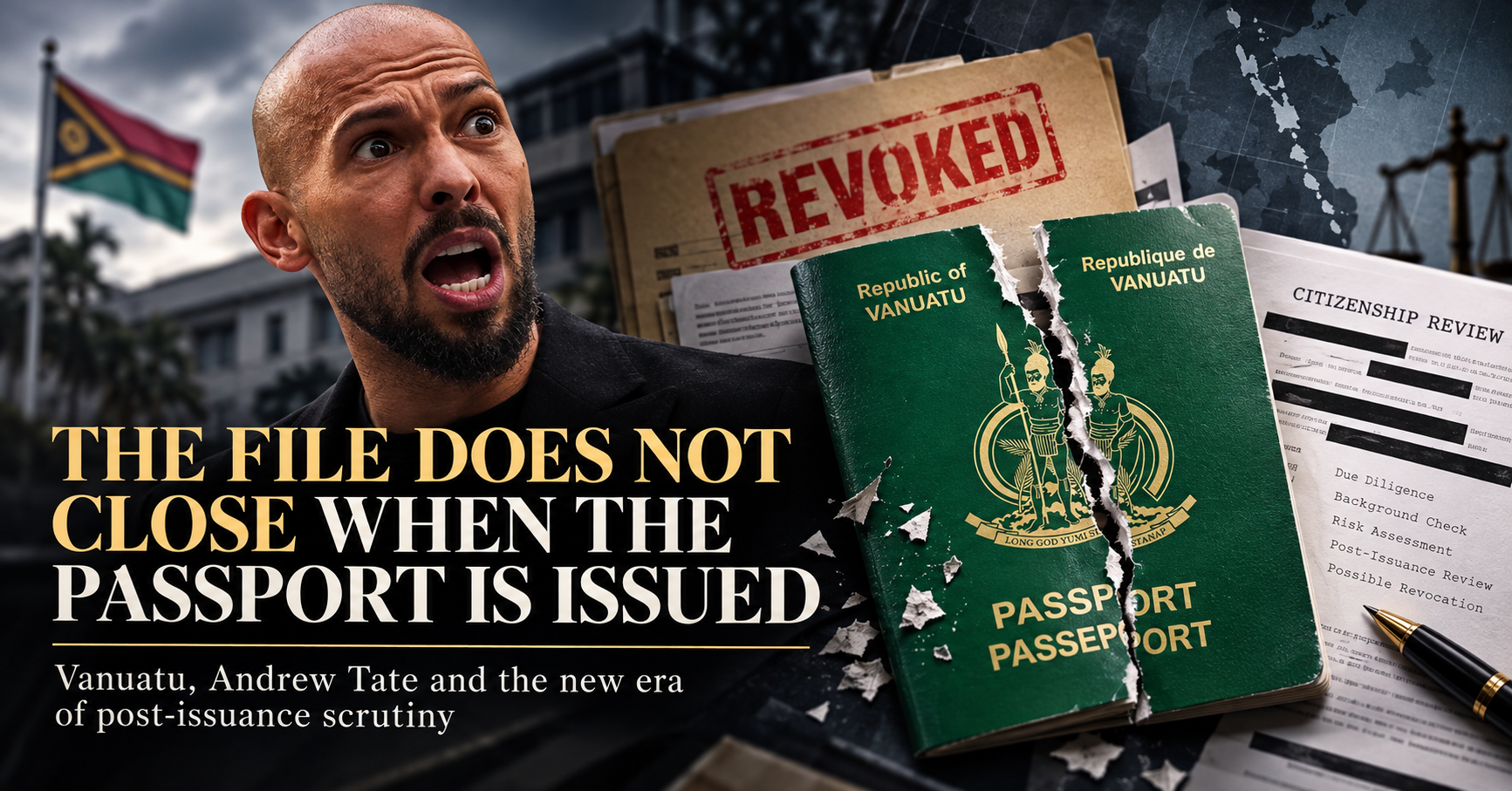
The File Does Not Close When the Passport Is Issued
Turkey's Interior Ministry has cancelled or withdrawn 6,134 citizenship decisions to date, and a separate investigation now covers 1,070 more people. Dublin has approved drafting a bill that adds a new national-security ground for revoking a naturalisation already granted. Citizenship is not getting cheaper or easier to obtain either: Jordan just raised its price. The common thread is that approval is no longer the end of the story. Turkey's Ministry of Interior states, in a statement carried by DHA, that 6,134 citizenship decisions have been cancelled or withdrawn to date: 5,391 people, including family members, after 1,150 investors had their investment eligibility certificates cancelled for fraudulent appraisals, and 743 people, including family, withdrawn afterwards on national-security or public-order grounds, 263 of them investors. Since 11 February 2026 specifically, a narrower window applies: 1,358 people (443 investor cases) cancelled, plus 7 more withdrawn for security reasons, a much smaller slice of the all-time total. Separately, an Istanbul investigation made public on 21 September identified a separate 1,070 people who acquired citizenship through sham property sales, 274 of 734 sales reviewed were found to be sham, with 11 more applications still in process. The ministry's own figures do not establish whether this 1,070 sits inside or outside the 6,134 total, so the two are best read separately rather than added together. The earlier, first-wave cases centred on low-value properties given inflated appraisals; the developers named in the new investigation, Gül İnşaat, Beyaz İnşaat and LİV İnşaat, are accused of sham sales backed by inflated appraisals, per Minister Gürlek's own description of the second wave. Of 88 named suspects, 73 have been detained, and 30 companies have been placed under court-appointed trustees. This isn't only a story about fraud. It's a demonstration that a citizenship file's exposure does not end at approval, when the underlying valuation, rather than the applicant's later conduct, becomes the basis for reopening a case after issuance.
Ireland
Ireland is writing the same lever into law Dublin’s Cabinet has approved priority drafting of the Irish Nationality and Citizenship (Amendment) Bill 2026. The General Scheme raises the standard naturalisation residence requirement to eight years, introduces language and civics tests, and adds a new ground for revoking citizenship already granted: public policy, public order or national security. Transitional protection covers only the residence calculation for applications already submitted; it is silent on the new tests and the new revocation power. The spousal route also tightens significantly. Price and access are moving too, and not in the applicant’s favour Jordan has raised its stock-exchange citizenship threshold from JD 1 million to JD 1.5 million, added a five-year holding period and a 10% concentration limit. The often-quoted JD 150,000 figure buys only residency, not citizenship. North Macedonia’s draft would scrap both the €400,000 and €200,000 investment routes in favour of a vague “special interest” test. Meanwhile the five Caribbean CBI states face a confirmed EU phase-out deadline of 1 June 2028; none has closed and no Schengen waiver has been suspended. Separately, Spain’s Congress has passed a bill granting nationality to Sahrawis born in Western Sahara before 1977 and their descendants, with no residence requirement. The bill now goes to the Senate.